
Facing a family dispute or a Divorce is tough enough. But when you start hearing words like “Ancillary Matters,” “Affidavit,” and “Writ,” it can feel like learning a new language. This complex family law terminology is confusing for almost everyone.
We created this simple family law glossary to help you understand what these key family law legal terms actually mean, so you can feel more in control.
Access
Access is the legal right for the parent who does not have Care and Control (see below) to spend time with the child. The Court will establish a schedule for access, which typically includes time on weekends, specific holidays, and overnight stays.
Affidavit
An Affidavit is a formal written statement of facts that you sign and swear (or affirm) is true. It must be signed in the presence of a Commissioner for Oaths. Affidavits are used to give your evidence to the Court.
Affidavit of Assets and Means (AOM)
This is a very important Affidavit. Both spouses must file an AOM that lists all their assets (like property, bank accounts, CPF) and means (income and expenses). You must be completely honest, as the Court uses this to decide how to divide assets and set Maintenance.
Ancillary Matters
These are all the important issues the Court must settle after it has granted the Divorce. The main ancillary matters are:
- The division of Matrimonial Assets.
- Child Custody, Care and Control, and Access.
- Maintenance for the ex-wife and children.
Annulment
This is different from a Divorce. An annulment is a legal process that declares a marriage null and void, as if it never happened. This is only possible for specific reasons, like if the marriage was not consummated or if one party was already married.
Bankruptcy

This is a legal status for a person who cannot pay their debts. This is very important in a Divorce because a bankrupt person’s assets are managed by an Official Assignee, which affects how Matrimonial Assets can be divided.
Care and Control
This refers to which parent the child will live with on a day-to-day basis. This parent is responsible for the child’s daily routine, like meals, school, and bedtime. The Court can grant joint care and control, but it usually grants it to one parent.
Central Provident Fund (CPF)
This is the national savings scheme in Singapore. The money that you and your spouse accumulated in your CPF accounts during the marriage is considered a Matrimonial Asset and will be divided by the Court.
Commissioner for Oaths
This is a person, often a lawyer, who is authorised by the Court to witness you signing your Affidavit. They formally certify that you have sworn or affirmed that the contents of your document are true.
Contested Divorce
This is when spouses cannot agree on one or more key issues. This could be the Divorce itself, the division of assets, or the arrangements for the children. Contested Divorces take longer, are more stressful, and cost more money.
Custody
Custody is about who has the authority to make major, long-term decisions for a child (under 21). This includes decisions about their education, religion, and significant, non-urgent medical treatments. The Court often grants Joint Custody to both parents.
Defendant
The Defendant is the person who receives the Divorce papers. If your spouse is the one who filed the Divorce papers, you are the Defendant.
Disclosure
This is the process where both parties must provide complete and honest financial details to each other and the Court. This includes bank statements, property valuations, and other documents supporting what is in your Affidavit of Assets and Means.
Desertion
This is another legal ground for a Divorce. It means your spouse has left you for a continuous period of at least two years without your agreement and with no good reason to leave.
Discovery
This is a formal Court process where one party can request specific documents from the other party. This is often used in divorce and family law terms when one person believes the other is not being fully honest in their financial disclosure.
Family Justice Courts (FJC)
This is the specific Court in Singapore that handles all family-related legal matters. This includes all Divorce cases, child custody issues, and applications for Personal Protection Orders.
Final Judgment
This is the final, official Court order that legally ends the marriage. You can usually apply for this three months after the Interim Judgment. This is the document you need to prove you are legally divorced, for example, to remarry.
Grounds for Divorce
This is the legal reason you must prove to the Court that your marriage has “irretrievably broken down”. In Singapore, you must use one of five facts: Adultery, Unreasonable Behaviour, Desertion, 3 Years’ Separation (with consent), or 4 Years’ Separation (no consent needed).
Housing & Development Board (HDB)
The HDB flat is often the most significant Matrimonial Asset for a couple. The Court has the power to make orders regarding the disposition of the flat, such as ordering it to be sold or transferred to a single person, but HDB rules on eligibility must still be met.
Interim Judgment
This is the first Court order that grants the Divorce. It confirms the marriage has broken down, but it does not finalise the Divorce. You are still legally married until the Final Judgment is issued.
Joint Custody
This is the most common custody order made by the Court in Singapore. It means both parents must cooperate and make major decisions for the child together. This includes decisions about their education, healthcare, and religion.
Legal Custody
This is another name for Custody. It refers to the authority to make major, long-term decisions for a child, not who the child lives with. This is a key piece of family law terminology that is often granted jointly to both parents.
Maintenance
This is a form of financial support. The Court can order a husband to pay maintenance for his ex-wife and children. In some specific cases (like if a husband is incapacitated), the Court may order a wife to pay maintenance to him.
Matrimonial Assets
These are all the assets acquired by either spouse, or both, during the marriage. This includes the family home (such as an HDB flat), cars, savings, CPF balances, stocks, and business shares acquired during your marriage.
Matrimonial Home
This is the property that you and your spouse (and children) lived in as a family. Even if one person bought the home before the marriage, if it was used as the family home, it is considered a Matrimonial Asset.
Mediation
This is a private and confidential process in which a neutral person, known as a Mediator, helps both spouses discuss their disagreements. The goal is to reach an agreement without a stressful Court battle. Mediation is often a required step in the Divorce process.
Nullity of Marriage
This is the legal process of “annulling” a marriage (see Annulment). It is a Court order that declares a marriage invalid, as if it never existed. This is different from a Divorce, which ends a legally valid marriage.
Order of Court
This is a formal, legally binding command or direction issued by a Judge. For example, an Order of Court will state exactly who has Care and Control of the children or how a bank account is to be divided.
Parenting Plan
If you have children under 21, you must submit this plan to the Court. It details the care arrangements for the children after the Divorce, including who they will live with, the access schedule for the other parent, and how big decisions will be made.
Personal Protection Order (PPO)
This is a Court order to stop a family member from committing family violence against you or your children. You can apply for a PPO at the Family Justice Courts, even if you are not filing for a Divorce.
Plaintiff
The Plaintiff is the person who starts the Divorce by filing the first set of legal documents (the Writ for Divorce) with the Court.
Reasonable Behaviour (Unreasonable Behaviour)
This is the most common ground used for Divorce. It means your spouse has behaved in such a way that you cannot reasonably be expected to continue living with them. This can include a wide range of actions, from financial irresponsibility to verbal abuse.
Separation
This is a ground for Divorce where you and your spouse have lived apart for a set period. If you both agree to the Divorce, you need to be separated for 3 years. If your spouse does not agree, you must wait until you have been separated for 4 years.
Service of Documents

This is the formal legal process of delivering Court documents to the other party (usually the Defendant). This is a required step to ensure that they are officially aware of the legal action.
Sole Custody
This is an order where only one parent has the authority to make major decisions for the child. The Court rarely orders this in Singapore and prefers to grant Joint Custody, unless it can be proven that it is impossible for the parents to cooperate.
Uncontested Divorce
This is when both spouses agree on all issues. This includes the reason for the Divorce, how to divide all Matrimonial Assets, and all arrangements for the children (custody, care, and access). This is the fastest, cheapest, and most amicable way to get a Divorce.
Variation
This is an application to the Court to change an existing Court order. For example, you can apply for a variation to change the amount of maintenance or the child’s access schedule if there has been a significant change in circumstances.
Writ for Divorce
This is the main document that the Plaintiff files in Court to begin the Divorce process. It states the reason for the Divorce (the “fact”) and what the Plaintiff is asking the Court to decide on.
Conclusion About Divorce and Family Law Terms
Understanding these basic family law terms is the first step in navigating your journey. While this glossary helps, having the right guide is essential. The process is personal and complex, and you do not have to go through it alone.
If you need clarity and support, the team at Tembusu Law is here to help. Contact us to speak with some of the best Divorce lawyers in Singapore and get the clear answers you deserve.
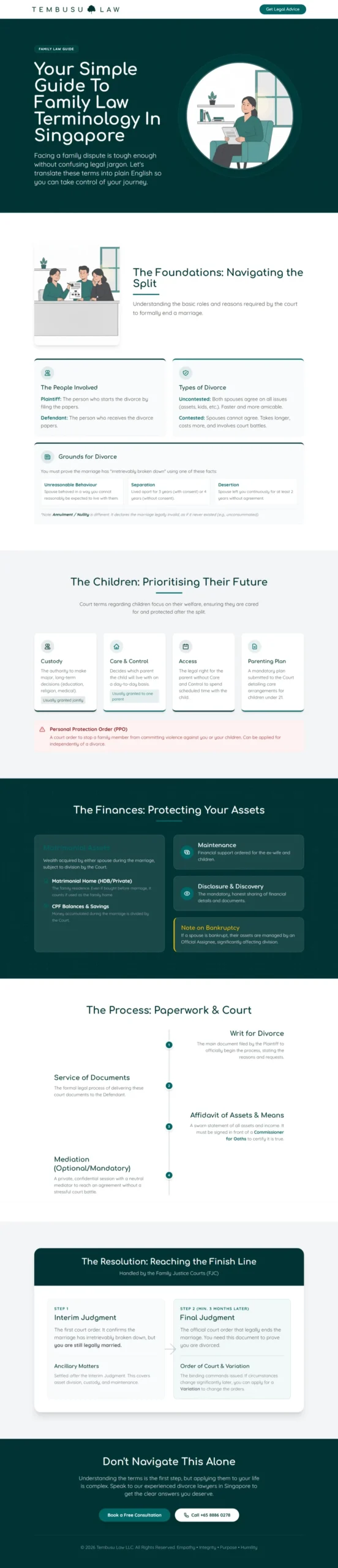
Frequently Asked Questions About Divorce and Family Law Terms
What Is The Difference Between Custody And Care And Control?
Custody is about the authority to make major decisions (like education or religion). Care and control refer to the person with whom the child lives every day. The Court often grants joint custody to both parents, but will award sole care and control to only one parent.
What Is Included in Matrimonial Assets?
Matrimonial assets generally include anything acquired during the marriage, like your home, CPF balances, bank savings, stocks, and cars. Assets acquired before the marriage are usually not included, unless they were used as the family home or substantially improved during the marriage.
How Long Do I Have to Wait Between the Interim Judgment and Final Judgment?
You must wait at least three months after the Interim Judgment is granted before you can apply for the Final Judgment. This period allows time for any appeal or for matters to be finalised.
What Is an Affidavit?
An affidavit is a written statement of facts that you swear or affirm is true. It is signed in the presence of a Commissioner for Oaths and is used as evidence in Court. Your Affidavit of Assets and Means is one example.
Do I Need a Lawyer to Understand This Terminology?
While you can learn the terms yourself, a lawyer helps you understand how they apply specifically to your situation. They can explain your rights and obligations and guide you on the best steps to take, which a glossary alone cannot do.