
Family trees can be wonderfully complex. We often have blended families with step-siblings and half-siblings, and our bonds with them are just as strong as any other. But when it comes to the law, especially after someone passes away, these relationships can raise important questions. One that often comes up is this: Can a half-brother be considered a next of kin?
It’s a question that brings up a lot of uncertainty during an already difficult time. When a person passes away without leaving a will, their assets are distributed according to a set of rules. The short answer is yes, a half-brother can be, but their place in the queue isn’t always straightforward.
Let’s look at how the law handles this.
What Does “Next of Kin” Mean for Inheritance?
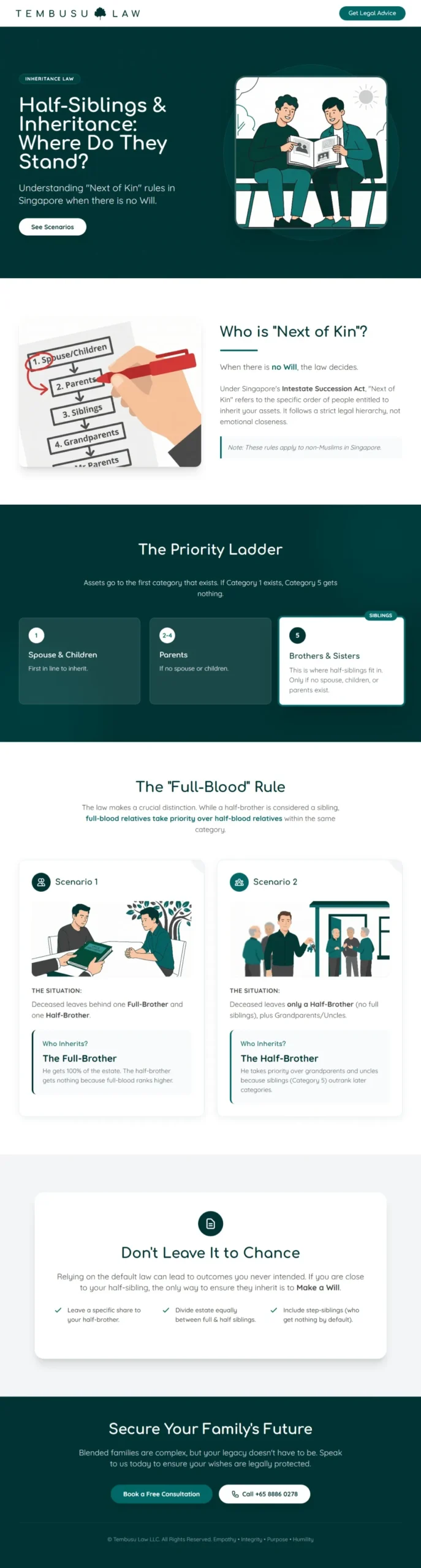
When there is no will, the term “next of kin” refers to the person or people who are first in line to inherit the deceased’s assets under Singapore’s Intestate Succession Act. This Act sets out a fixed order of priority. It is not about who the deceased was emotionally closest to, but about a clear legal hierarchy.
These rules apply to non-Muslims in Singapore. If a person dies “intestate” (the legal term for dying without a valid will), this Act is the rulebook for distributing everything they owned, from bank accounts to property.
How Does the Law Decide Who Inherits?

The Intestate Succession Act has a clear list of beneficiaries. The estate is distributed to the first category of relatives that exists, and lower-ranking categories will not receive anything.
Here is the general order of priority:
- Spouse and children
- Spouse and parents (if there are no children)
- Children (if there is no spouse)
- Parents (if there is no spouse or children)
- Brothers and sisters (if no spouse, children, or parents)
- Grandparents
- Uncles and aunts
Our main question about half-brothers falls into category 5.
So, Where Do Half-Brothers Fit In?
This is where the law makes a specific distinction. A half-brother is absolutely considered a sibling. However, the Act also states that relatives of the “full blood” are prioritised over relatives of the “half blood” who are in the same category.
This means a half-brother’s right to inherit depends entirely on whether the deceased also had “full” siblings.
To clarify, let’s examine two common scenarios.
Scenario 1: The Deceased Has a Full-Brother AND a Half-Brother
Imagine the deceased has no surviving spouse, children, or parents. They leave behind one full brother (who shares both parents) and one half-brother (who shares one parent).
- Who Inherits? The full brother will be entitled to the entire estate.
- Why? Because the full-blood sibling ranks higher, the half-blood sibling (the half-brother) does not get a share.
Scenario 2: The Deceased Only Has a Half-Brother
Now, imagine the same situation, but the deceased has no full siblings. They only leave behind a half-brother. They may also have living grandparents, uncles, or aunts.
- Who Inherits? The half-brother will be entitled to the entire estate.
- Why? As a sibling (even of half-blood), the half-brother is higher in the order of priority (category 5) than grandparents (category 6) or uncles and aunts (category 7).
Why Is Having a Will So Important?

Relying on the Intestate Succession Act means you are letting a default set of rules decide your legacy. This can sadly lead to outcomes you never intended. Your half-brother, to whom you might have been very close, could be left with nothing if you also have a full sibling.
The only way to ensure your assets are distributed exactly as you wish is to have a valid will.
A will allows you to bypass the Act’s hierarchy. You can decide to:
- Leave a specific share to your half-brother.
- Divide your estate equally between your full-siblings and half-siblings.
- Include step-siblings, friends, or charities, who are not covered by the Act at all.
This simple document provides clarity for your loved ones and can prevent misunderstandings or painful disputes that may otherwise end up in Court, which is often the last thing a family needs during a time of grief.
Conclusion About Considering Half-Brother as Next of Kin in Singapore
A half-brother’s legal right to your estate is conditional and depends entirely on your family structure. While the law provides a backup plan, it may not reflect your personal wishes.
If you are in a blended family or simply want to ensure your intentions are clear, do not leave it to chance. To ensure your assets are distributed exactly as you wish and to protect all your loved ones, speak to the best family and Divorce lawyers in Singapore at Tembusu Law.
Contact us today for a free 10-minute discovery call.
Frequently Asked Questions About Considering Half-Brother as Next of Kin in Singapore
What Is The Intestate Succession Act?
The Intestate Succession Act is a law in Singapore that determines how a person’s assets are distributed if they pass away without making a valid will. It only applies to non-Muslims and sets out a fixed order of priority for relatives.
Do These Rules Apply To Muslims?
No. The distribution of a Muslim’s estate is governed by Muslim law and the Administration of Muslim Law Act. The Intestate Succession Act does not apply.
Does A Half-Sister Have The Same Rights As A Half-Brother?
Yes. The law is gender-neutral in this regard. A half-sister is treated the same as a half-brother. She will rank after full-blood siblings but before grandparents, uncles, and aunts.
What Happens If My Half-Sibling Passed Away Before The Deceased?
If a half-sibling (who would have been entitled to a share) passes away before the deceased, their share may go to their own children, if they have any. These children (the deceased’s nieces or nephews) would legally “stand in the shoes” of their parent.
Are Step-Siblings Considered Next Of Kin?
No. Step-siblings (who share no common parent with the deceased) are not recognised as legal relatives under the Intestate Succession Act. They have no right to inherit any part of the estate unless they are specifically named in a will.