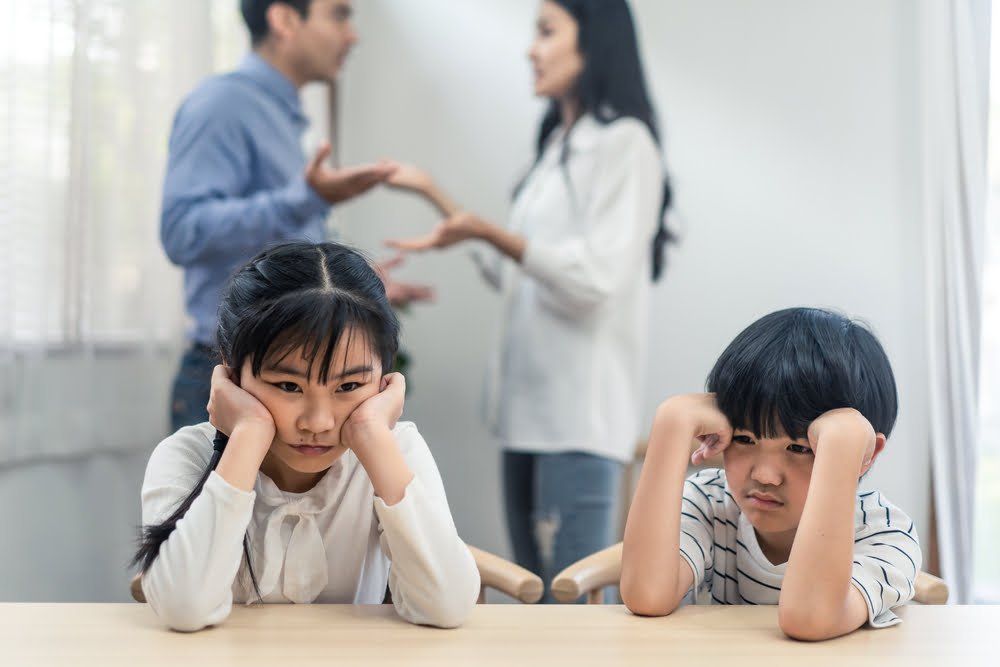
Fear of losing contact with their children is often one of the main reasons why people in unhappy marriages choose to stay married.
But when you have legal grounds for divorce and splitting up is in the best interest of your mental and emotional health, a good understanding of the laws of Family Court can help you and your divorce lawyer work together to achieve the best possible outcome when going through a Divorce in Singapore with a kid.
Key Legal Divorce Terms Related To Children

The Women’s Charter is the main source of statutory law related to family law in Singapore, which means many of the terms related to divorce are defined by the charter.
#1. Child
A child is a child of marriage who is under 21 years of age.
#2. Child Custody
If someone has custody over a child, they are granted authority to make major decisions related to the child’s upbringing and welfare, including matters such as healthcare, education, and religion, until the turns 21. There are 4 different types of custody:
- Sole custody: Only one parent is granted custody and is the sole decision-maker for the child.
- Joint custody: Both parents are decision-makers for the child, but both parents need to cooperate and communicate with each other and reach a consensus before making key decisions.
- Hybrid order: Only one parent is granted custody of the child, but the custodial parent must consult the non-custodial parent on matters related to the child’s welfare.
- Split custody: Custody of one or more siblings is granted to one parent, while custody of the other siblings is granted to the other parent.
Child custody orders are determined by a Family Court judge based on the standard known as the “welfare principle”. This means that the court prioritises the best interests of the child, not the desires of the parent.
There are several factors that go into evaluating this – the parent with higher financial ability does not necessarily have a clear advantage when it comes to custodial arrangements.
#3. Care And Control
Care and control determine which parent the child will live with. That parent will be the child’s primary caregiver and be responsible for the child’s day-to-day life.
Unlike custody orders, care and control orders can be granted to only one parent.
It is generally more difficult for fathers to be granted care and control over mothers, but there are exceptions, like in cases of neglect or domestic abuse, if there is agreement from the mother, or if there is an explicit request from the child. Nonetheless, it is not an impossible task.
#4. Access
The parent who is not granted care and control will still be allowed reasonable access to the child. The Women’s Charter does not explicitly state how much access should be granted, so it is up to the court to decide what is “fair and reasonable”.
In rare cases, a parent may be denied access or only be granted supervised access if sufficient evidence is presented that proves unsupervised access will put the child at risk of physical or emotional harm.
#5. Child Maintenance
In Singapore, every parent has a legal duty to maintain and support their child. This duty exists until the child turns 21, and applies regardless of whether the child is legitimate, whether the parents are married or divorced, and persists even after either parent remarries.
The court can order the payment of child maintenance in the form of a lump sum or monthly allowance. When deciding on an appropriate amount of child maintenance to be paid, the court will consult section 69(4) of the Women’s Charter, which takes into account:
- The child’s financial needs and expenses
- The parent’s income, earning capacity, or other financial resources
- Any physical or mental disability of the child
- The ages of both spouses
- The duration of the marriage
- The contributions made by both parties to the family’s welfare before filing for divorce
Children over the age of 21 may still be entitled to maintenance under section 69(5) of the Women’s Charter, but they will need to apply for child maintenance themselves. Adult children entitled to maintenance include:
- Those with physical or mental disabilities
- Those who are currently serving or will be serving full-time national service
- Those still schooling or undergoing vocational or trade training
- Special circumstances that satisfy the court that the provision of maintenance is necessary
What Happens To Kids In A Divorce?

A crucial part of understanding how to divorce with children is recognising that the impact on them can vary significantly depending on their age, personality, and the circumstances of the divorce. Initially, most children experience a significant emotional impact, which can manifest as sadness, anxiety, or even anger.
Younger children might struggle to understand why their parents are no longer together, while teenagers may feel a range of emotions and might even take sides.
Over the long term, the effects of divorce can extend to academic performance, social interactions, and behaviour. Children might face difficulties in school or withdraw from friends and activities they once enjoyed.
The stability of their living arrangements plays a crucial role in how well children adapt. Frequent moves or changes in living situations can exacerbate stress and lead to more profound emotional issues.
Who Gets The House In A Divorce With Children?
Deciding who gets the house in a divorce can be complex, especially when children are involved. The primary concern is usually the welfare of the children, which often influences the decision on which parent remains in the family home.
The courts typically favour stability for the children, which means allowing them to continue living in their primary residence to minimise disruption in their lives.
This decision also depends on several factors, including the financial situations of the parents, the house’s proximity to the children’s schools and social circles, and sometimes the children’s preferences, depending on their age.
If neither parent can maintain the home on their own, the court may order the house to be sold and the proceeds divided, with the children’s living arrangements re-evaluated to best support their ongoing development.
Who Gets Child Custody After Divorce In Singapore?

In Singapore, custody decisions revolve around the child’s welfare, aiming to ensure they grow up in a supportive, stable environment.
The court usually grants joint custody, meaning both parents share decision-making responsibilities for essential aspects of the child’s life, such as education, religion, and healthcare. However, care and control are often given to the mother, allowing her to manage the everyday aspects of the child’s life.
Several factors influence these decisions:
- Child’s Current Living Arrangement: Stability is key. If a child is settled in their environment, the court generally prefers to maintain this arrangement to avoid unnecessary disruptions.
- Primary Caregiver: The parent who has been most involved in day-to-day care is more likely to be granted care and control. This consideration ensures that the child’s daily routines continue with minimal interruption.
- Financial Stability of Each Parent: While not the sole factor, the financial capability of each parent to provide for the child is considered, covering basics like housing, education, and day-to-day needs.
- Child’s Preferences: Depending on their age and maturity, a child’s preferences may be considered.
The court retains the flexibility to adjust these arrangements based on what it deems best for the child’s overall well-being.
What Happens If I File For Divorce?

Work with your lawyer to outline your ideal outcome for both you and your children. If you and your spouse are able to come to a consensus, an uncontested divorce is ideal as it involves less time, stress, and divorce lawyer fees.
In the event of no consensus and you enter into a contested divorce, your lawyer will argue your case for you in court. If the grounds for divorce are adultery or domestic abuse, it will be helpful to gather evidence to support your case.
Once the Family Court judge has heard from both sides, a final decision will be made about what happens to the children once the divorce is finalised.
How To Go Through A Divorce With A Child?
Navigating a divorce with children requires careful consideration of their needs and emotions. In Singapore, the process can follow either simplified or normal track proceedings.
- Simplified Proceedings: This route is faster and less stressful. It is suitable when both parties agree on all terms, including child custody and division of assets. It allows families to move forward with minimal disruption.
- Normal Track Proceedings: If disagreements arise, the divorce will likely enter this more comprehensive process involving mediation and possibly court hearings. This track addresses disputes over children’s welfare, living arrangements, and financial support comprehensively.
For parents, the focus should be on minimising conflict and ensuring that emotional support for the child is maintained throughout the process. It’s advisable to seek legal and psychological guidance to manage the complexities of divorce and to support the child through the transition.
Requirements For An Uncontested Divorce With Children

In Singapore, for an uncontested divorce involving children to proceed smoothly, both spouses must agree on several critical aspects concerning their children and their mutual assets. Here’s what needs to be agreed upon:
- Custody: This involves decisions on who will make significant long-term decisions affecting the children’s lives, such as their education, religious upbringing, and major health decisions.
- Care and Control: It’s crucial to decide where the children will live and who will make day-to-day decisions affecting their daily lives, including mundane things like meals and clothing.
- Access Arrangements: Both parties must agree on how the non-custodial parent will maintain a relationship with the children, specifying the frequency and type of contact.
- Child Maintenance: The amount and terms of financial support for the children must be clearly outlined.
Additionally, for a divorce to be considered uncontested, there must also be agreement on:
- Reason for Divorce: Both parties must concur on the grounds for the divorce, whether it be adultery, separation for a stipulated period, unreasonable behaviour, or desertion.
- Division of Matrimonial Assets: There must be a comprehensive plan for dividing assets like property, investments, and other financial resources.
- Spousal Maintenance: If applicable, there must be a consensus on the need for, amount, and duration of spousal maintenance.
Agreement on these points can significantly expedite the divorce process, allowing both parties to avoid lengthy disputes and legal costs.
How Child Maintenance Is Determined During Divorce
Determining child maintenance during a divorce in Singapore takes into account multiple factors, with the court aiming to ensure that the child’s needs are met without adhering to a strict formula. Here are the main considerations:
- Child’s Financial Needs: The basic and educational expenses, health care, and any special needs of the child are assessed.
- Parental Income and Financial Resources: The income and financial capacity of both parents play a crucial role in determining the maintenance.
- Child’s Standard of Living: The lifestyle the child was accustomed to before the divorce is considered, aiming to minimise the impact of the divorce on the child’s daily life.
- Special Needs of the Child: If the child has any special requirements, such as medical conditions or educational needs, these are given particular attention.
The income ratio approach is frequently utilised, especially when both parents are earners. This method calculates child maintenance based on the relative incomes of the parents, ensuring that each parent contributes a fair proportion towards the child’s upbringing, reflective of their financial ability.
Mediation vs. Litigation: Which Path Is Better for Your Children?
In Singapore, the two primary paths are mediation and litigation. While both lead to a legal conclusion, their impact on a child’s well-being is vastly different.
Litigation is the traditional Court process where you and your spouse present your cases to a judge, who then makes a final, binding decision. This process is adversarial by nature, it often positions parents against each other, with each side trying to “win.” For children, this can be a highly stressful experience. The confrontational nature of litigation can permanently damage the co-parenting relationship, making it difficult for parents to work together for their children’s benefit after the Divorce.
Mediation, on the other hand, is a collaborative and less formal process. Under the guidance of a neutral third-party mediator, you and your spouse discuss and resolve disputes amicably. In Singapore, mediation is a cornerstone of the family justice system and is often mandatory before you can proceed to a full Court hearing.
The Family Justice Courts actively encourage this approach through a judge-led process. For cases involving children under 21, parties often attend sessions at the Child-Focused Resolution Centre (CFRC). Here, specially trained judges and family counsellors help parents:
- Focus on the Child’s Best Interests: The entire process is structured to prioritise the child’s welfare over parental disagreements.
- Improve Communication: Mediation provides a safe space for parents to learn how to communicate respectfully and effectively.
- Create a Customised Parenting Plan: Parents work together to craft a detailed agreement covering custody, care and control, and access arrangements that suit their family’s unique needs.
The Role of a Child Representative in Divorce Proceedings
A Child Representative is an independent, qualified professional, usually a lawyer from a panel of specialists appointed by the Family Justice Courts, who acts as the voice of the child in the legal proceedings. Their sole duty is to represent the child’s best interests, separate from the wishes of the parents.
A Child Representative is typically appointed in complex situations, such as:
- When there are allegations of family violence, abuse, or neglect.
- When a child has strong, independent views but is not old enough to express them formally in Court.
- When there are concerns about parental alienation, one parent attempts to turn the child against the other.
- When parents have intractable disputes over custody, education, or medical treatment for the child.
The Child Representative’s responsibilities include:
- Meeting the Child: They will speak with the child in an age-appropriate manner to understand their feelings, fears, and wishes.
- Gathering Information: They may interview parents, teachers, counsellors, and other relevant individuals to get a complete picture of the child’s life.
- Making Recommendations: After a thorough investigation, the Child Representative will submit a report and make recommendations to the Court regarding custody, care and control, and access arrangements that best serve the child’s welfare.
The Mandatory Co-Parenting Programme (CPP): What You Need to Know
In Singapore, the law recognises that even after a Divorce, both parents share a lifelong responsibility for their children. To ensure parents are equipped for this journey, attending the Mandatory Co-Parenting Programme (CPP) is a compulsory first step for any parent wishing to file for Divorce.
The CPP is a one-time consultation session conducted by counsellors from a Divorce Support Specialist Agency (DSSA) appointed by the Ministry of Social and Family Development (MSF).
Who Must Attend? It is compulsory for all parents with at least one child under the age of 21 to complete the CPP before they can file for a Divorce in Singapore. This applies whether the Divorce is contested or uncontested. You will not be able to file your Divorce papers with the Court without the CPP certificate of completion.
What is the Purpose of the CPP? The programme is designed to help parents make informed decisions that prioritise their children’s needs during and after the Divorce. The key objectives are to:
- Educate Parents: Help them understand the short-term and long-term impact of Divorce on children.
- Promote Cooperative Co-Parenting: Provide strategies for effective communication, conflict resolution, and joint decision-making.
- Focus on the Child’s Well-being: Encourage parents to develop a child-centric Parenting Plan that outlines arrangements for custody and care.
During the consultation, parents will discuss their specific family situation and receive personalised guidance on what happens when you divorce with a child and how to help them adjust to the changes. The programme aims to shift the mindset from “ending a marriage” to “restructuring the family,” ensuring that children continue to have the love and support of both parents.
Conclusion About Child Custody After Divorce In Singapore
Check out our Divorce & Family Law FAQs if you have more questions related to divorce, child custody, family violence, division of matrimonial assets, and more.
Our highly experienced and empathetic team of divorce lawyers in Singapore will always work to achieve the best possible outcome for you and your children. If you are seeking assistance in matters related to criminal law, our team of criminal lawyers in Singapore is also available to provide expert legal counsel.
Get in touch with us to discuss how we can help, or if you have any questions regarding divorce lawyer in Singapore fees.
Frequently Asked Questions About Child Custody After Divorce In Singapore
Can A Child Choose Which Parent To Live Within A Singapore Divorce Case?
In Singapore, while a child’s preferences are considered, the final decision on custody is not solely based on this choice.
The court assesses the child’s maturity and understanding of the situation before giving weight to their preference. Ultimately, the decision is based on the child’s best interests, taking into account various factors beyond just the child’s desires.
What Role Do Family Counsellors Play In Divorce Proceedings Involving Children?
Family counsellors are integral in divorce cases, helping to mediate between parents and ensuring the emotional well-being of children is considered.
They provide professional assessments and recommendations to the court regarding custody and access arrangements. Counsellors also offer support and guidance to the family throughout the legal process to facilitate healthier communication and adjustment.
How Can Divorced Parents Manage Co-Parenting Without Conflict?
Effective co-parenting without conflict involves open and respectful communication, clear boundaries, and a consistent parenting approach. Parents should prioritise their children’s needs above personal differences and collaborate on decisions affecting the child’s welfare.
Utilising tools like co-parenting apps and agreeing on specific guidelines for engagement can also help in maintaining a harmonious arrangement.
When Should A Parent Apply For An Interim Custody Order During A Divorce?
A parent should apply for an interim custody order when immediate decisions about the child’s care and living arrangements need to be established to protect the child’s well-being during divorce proceedings.
Such orders are crucial if there is a concern about the child’s safety or if a parent plans to relocate with the child before the divorce is finalised.