
Many people consider how their assets will be distributed after they pass away. For Muslims, Faraid (Islamic inheritance law) provides a default path. But what if you want to give a specific asset to a specific person, perhaps someone who isn’t a Faraid heir, like an adopted child? Or you may want to give more to a child who has been your main caregiver.
This is where understanding hibah in Singapore becomes so important. It’s a powerful way to gift your assets while you are still alive, giving you control, flexibility, and peace of mind for your family’s future.
What Is a Hibah?
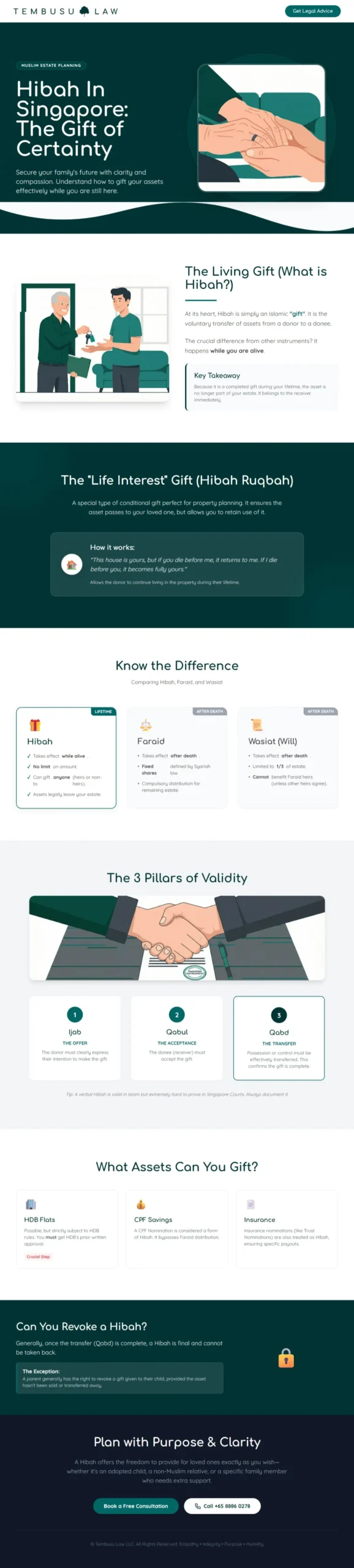
At its heart, a Hibah is an Islamic “gift”. It is as simple as that.
In a more technical sense, it is the act of one person (called the donor, or the giver) willingly giving an asset they own to another person (called the donee, or the receiver).
The most important part of a Hibah is that the transfer happens while the donor is alive. This is completely different from a Will (Wasiat) or Faraid (Islamic inheritance law), which only deal with your assets after you have passed away.
Think of it as an ‘advance’ gift. Because it is a gift given and completed during your lifetime, the asset is no longer considered part of your estate. It already belongs to the donee.
What is a Hibah Ruqbah (Conditional Gift)?

A Hibah Ruqbah is a special type of conditional gift. The donor basically says, “This asset is yours, but if you die before me, it comes back to me. If I die before you, it is fully yours.” It’s a way of gifting an asset, such as a house, whilst allowing the donor to continue living in it.
How is Hibah Different from Faraid and a Wasiat (Will)?
This is the most common question people have, and the differences are important.
- Hibah vs Faraid: Faraid refers to the compulsory distribution of assets after death, as outlined in the Quran, according to fixed shares. A Hibah, however, is a gift made during your lifetime. Assets that you have successfully gifted via Hibah are no longer part of your estate, so they are not subject to Faraid distribution when you pass away.
- Hibah vs Wasiat (Will): A Wasiat (an Islamic Will) only takes effect after death. Under Singapore’s Administration of Muslim Law Act (AMLA), a Wasiat is limited. You can only will away up to one-third (1/3) of your estate, and only to beneficiaries who are not already Faraid heirs (like a charity or an adopted child). A Hibah has no such restrictions. You can gift any amount of your assets to anyone, including your Faraid heirs.
What Makes A Hibah Valid?
For a Hibah to be valid, three main conditions must be met:
- The Offer (Ijab): The donor must clearly express their intention to make the gift.
- The Acceptance (Qabul): The donee (the person receiving the gift) must accept it.
- The Transfer (Qabd): The possession or control of the asset must be transferred from the donor to the donee. This is a crucial step that confirms the gift has been completed.
What Assets Can You Gift Using Hibah?

You can gift most assets, but some have special rules in Singapore.
Gifting HDB Flats
This is a big one. You can gift an HDB flat using a Hibah, but it is also subject to HDB’s rules. You must get HDB’s prior written approval for the transfer. If you do not, the transfer is not valid under civil law, even if you have a Hibah document.
CPF Savings
This is a common question. A fatwa (religious ruling) in Singapore has clarified that a CPF nomination is considered a form of Hibah. When you make a CPF nomination, you are essentially gifting your CPF savings to your chosen nominees. This distribution takes precedence over Faraid.
Insurance Policies
Similar to CPF, you can nominate beneficiaries for your insurance policies. Depending on the type of nomination (like a trust nomination), this is also treated as a form of Hibah, ensuring the payout goes directly to the person you named.
Can You Revoke or Cancel a Hibah?
This depends. Generally, once the asset has been transferred and possession is complete (the qabd), the Hibah is final and cannot be taken back. However, Islamic scholars widely agree that a parent has the right to revoke a Hibah given to their own child, as long as the asset hasn’t been sold or transferred to someone else.
Why Should You Consider a Hibah?
Planning your estate isn’t just a legal task; it’s an act of care. A Hibah gives you the freedom to provide for your loved ones exactly as you wish. You might want to give a larger share to a child who needs more support, or provide for a loved one who isn’t a Faraid heir. It offers flexibility that Faraid and Wasiat alone do not, allowing you to settle your affairs and prevent potential disputes.
Conclusion About Hibah In Singapore
Estate planning, especially when navigating both Syariah and civil law, can feel complex. A Hibah is a powerful and flexible tool, but it must be structured correctly to be legally binding and avoid future disputes, particularly in complex matters that might lead to a Divorce or challenges in Court.
Understanding your options is the first step to securing your family’s future. If you need clarity on how hibah in Singapore can work for you, or require assistance with other family law matters, speak to our team at Tembusu Law, home to some of the best family and Divorce lawyers in Singapore.
Contact us today for a free 10-minute discovery call.
Frequently Asked Questions About Hibah In Singapore
What Is The Main Difference Between A Hibah And a Faraid?
A Hibah is a gift made during your lifetime, giving you control over who receives the asset. Faraid is the automatic and fixed distribution of your remaining estate after your death, as prescribed by Islamic law.
Can I Give A Hibah To A Non-Muslim?
Yes, you can. Hibah is a gift, and you are free to gift your property to anyone you choose, regardless of their faith. This is one way to provide for non-Muslim family members (like an adopted child or non-Muslim parents) who would not inherit under Faraid.
Is A Verbal Hibah Valid?
Islamically, a verbal offer and acceptance can be valid if possession is transferred. However, for legal and practical purposes in Singapore, especially with assets like property or bank accounts, a verbal Hibah is extremely difficult to prove in Court.
Does A Hibah Need To Be In Writing To Be Legal?
Yes. To be enforceable under Singapore’s civil law and to prevent any disputes, a Hibah should always be documented in writing, usually through a formal “Deed of Gift”. This document provides clear evidence of your intention, the acceptance, and the transfer.
What Happens If My Hibah Is Challenged In Court?
A Hibah can be challenged if someone claims it was not valid. They might argue you were forced, did not have the mental capacity, or that the transfer of possession never actually happened. This is why having it properly documented by a lawyer is so important.