
Have you ever made a promise to do something good if a specific wish of yours came true? Perhaps you said, “If I recover from this illness, I will donate $1,000 to charity.” In Islam, this act of making a conditional vow is known as a Nuzriah (or nazar). It’s a common practice, but many people wonder about the legal standing of a nuzriah in Singapore.
Let’s talk about what a Nuzriah is, whether it’s binding, and how it’s handled under the law here.
What Exactly is a Nuzriah (Nazar)?
This is a great place to start. A Nuzriah, which you might also hear called a nazar in Singapore, is essentially a conditional vow made to God.
Think of it this way: it’s an “if-then” promise. A person (known as the Nathir) makes a declaration, saying something like, “If [my specific wish happens], then I will [perform a specific good deed].”
Here are a couple of common examples:
- “If my child recovers from her illness, I vow to donate $1,000 to the orphanage.”
- “If I secure the new job I am interviewing for, I will fast for three days.”
The most important part of a Nuzriah is that it is conditional. The person is not obligated to perform the good deed until their wish is granted. If the child doesn’t recover, or if the person doesn’t get the job in these examples, then the vow does not come into effect. It’s a self-imposed obligation that is only activated by a specific outcome.
Is a Nuzriah Legally Recognised in Singapore?

Yes, absolutely. This is a crucial point that many people are unaware of. A Nuzriah is not just a personal religious promise; it has real legal standing for Muslims in Singapore.
The validity and enforcement of a nuzriah in Singapore falls under the Administration of Muslim Law Act (AMLA).
This is significant because it means that if there is a dispute over a Nuzriah, it can be taken to Court. The Syariah Court has the specific jurisdiction (the power and authority) to hear and rule on these cases. The Court can determine:
- Whether a Nuzriah is valid in the first place.
- Whether the condition of the vow has been met.
- What happens if the person (the Nathir) fails to fulfil their promise after the condition is met?
So, while it starts as a personal vow, it can become a legally enforceable duty, much like a debt, especially if it involves property or a sum of money.
How Do You Make a Valid Nuzriah?
For a Nuzriah to be considered valid and binding under Muslim law, it’s not enough to just think it. Several conditions must be met. Let’s break them down.
1. The Person Making the Vow (The Nathir)
The person making the vow must be someone who can be held responsible for their promises. This means they must be:
- An adult (mukallaf): They must have reached the age of maturity.
- Of sound mind: They must understand the nature and consequences of the vow they are making.
- Acting on free will: The vow cannot be made under threat or force. It must be a willing and voluntary promise.
2. The Wording and Intention (Sighah)
The words used must be clear and show a firm intention to make a binding vow.
- Vague statements like, “I’m thinking about donating if I get better”, are generally not enough.
- The wording should be explicit, such as “I make a Nuzriah…” or “I vow to God…” This shows a clear intent to create an obligation.
3. The Condition (The “If”)
The condition that triggers the vow must be something that is possible and permissible.
- You cannot make a vow based on an impossible condition (e.g., “If I can fly”).
- It should also not be based on something sinful. For example, a vow conditional on winning the lottery would be questionable, as gambling is not permitted.
4. The Vowed Act (The “Then”)
This is the act you promise to perform. It must be a good, permissible deed (ibadah).
- Valid acts: These include things like giving to charity, fasting, performing extra prayers, or helping someone in need.
- Invalid acts: You cannot make a valid Nuzriah to do something forbidden (haram) or to omit an already-existing obligation (like, “I vow to stop performing my daily prayers,” which would be invalid). You also cannot vow to harm someone or commit a sinful act.
A Quick Note: Should It Be in Writing?
While a verbal Nuzriah can be perfectly valid (especially if there are witnesses), it is highly recommended to put it in writing. Having a written document is extremely helpful to avoid any confusion or disputes later on, particularly if the vow involves a large sum of money or property that might affect your family or heirs.
Nuzriah vs. Hibah (Gift) vs. Wasiat (Will): What’s the Difference?

This is a common point of confusion. Let’s clear it up with this simple table.
| Feature | Nuzriah (Vow) | Hibah (Gift) | Wasiat (Will) |
| When does it take effect? | Only when a specific condition is met. | Immediately, during the giver’s lifetime. | Only after the person’s death. |
| Is it conditional? | Yes, it is always conditional. | No, it is an outright gift. | No, it is a declaration of intent for after death. |
| Can it be revoked? | Generally, no, not after the condition is met. | It can sometimes be revoked, depending on the situation. | Can be revoked or changed anytime before death. |
Can Someone Challenge a Nuzriah in Court?
Yes, a Nuzriah can be challenged. Family members or other interested parties might contest it in the Syariah Court.
A challenge often happens if someone believes the Nuzriah is not valid. For example, they might argue that:
- The person making the vow was not of sound mind.
- The vow was made under duress or force.
- The conditions for a valid Nuzriah (as listed above) were not met.
The Court will then examine the evidence to decide if the Nuzriah is valid and enforceable.
Conclusion About Nuzriah in Singapore
Making a nazar in Singapore is more than just words; it’s a binding promise that is recognised by the law. It creates a religious and legal obligation that must be fulfilled if the condition comes true. Because it can have a big impact on your assets and family, it’s important to understand what you are doing.
If you are facing complex family law issues, such as those related to inheritance, assets, or a Divorce, understanding your legal standing is essential. For clear guidance on Muslim family law matters, it’s always best to speak with experienced professionals.
Our team at Tembusu Law is ready to help you navigate your situation with clarity and compassion, which is why we are recognised among the best Divorce and family lawyers in Singapore.
Contact us today for a free discovery call.
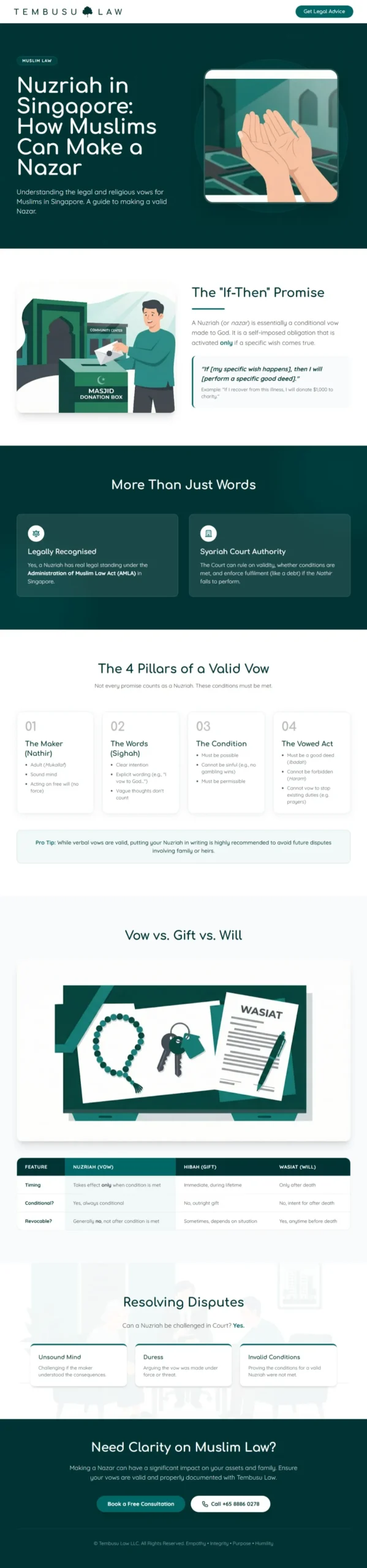
Frequently Asked Questions About Nuzriah in Singapore
What If The Person Who Made The Nuzriah Dies Before Fulfilling It?
If the condition was met before their death, the Nuzriah becomes a debt on their estate. It must be paid or fulfilled from their assets before the remaining assets are distributed to the heirs according to Faraid (Muslim inheritance law).
Can A Nuzriah Be Made For Something Bad Or Sinful?
No. A vow to perform an act that is forbidden (haram) or undesirable (makruh) in Islam is not valid and is not binding.
Does A Nuzriah Need To Be In Writing To Be Valid?
Not necessarily. A verbal Nuzriah can be valid if the intention and wording (sighah) are clear and there are witnesses. However, it is strongly advised to put it in writing to avoid any disputes or confusion later.
Who Has The Power To Decide On Nuzriah Disputes?
In Singapore, the Syariah Court has the jurisdiction and authority to hear and make rulings on any matters or disputes related to Nuzriah involving Muslims.
Is A Nuzriah The Same As Faraid (Muslim Inheritance Law)?
No. Faraid is the system of fixed-share inheritance prescribed by Islamic law for distributing a deceased person’s estate. A Nuzriah is a specific vow that, if valid and unfulfilled, is treated as a debt to be paid before Faraid distribution.