
When a marriage faces difficulties, Divorce isn’t always the immediate or only path. Sometimes, couples need space and time apart to reflect or make arrangements before taking that final step.
You might wonder about the different methods of separation available in Singapore if you’re considering living apart from your spouse before formally ending the marriage through the Court. Understanding these options is important for making informed decisions during a challenging time.
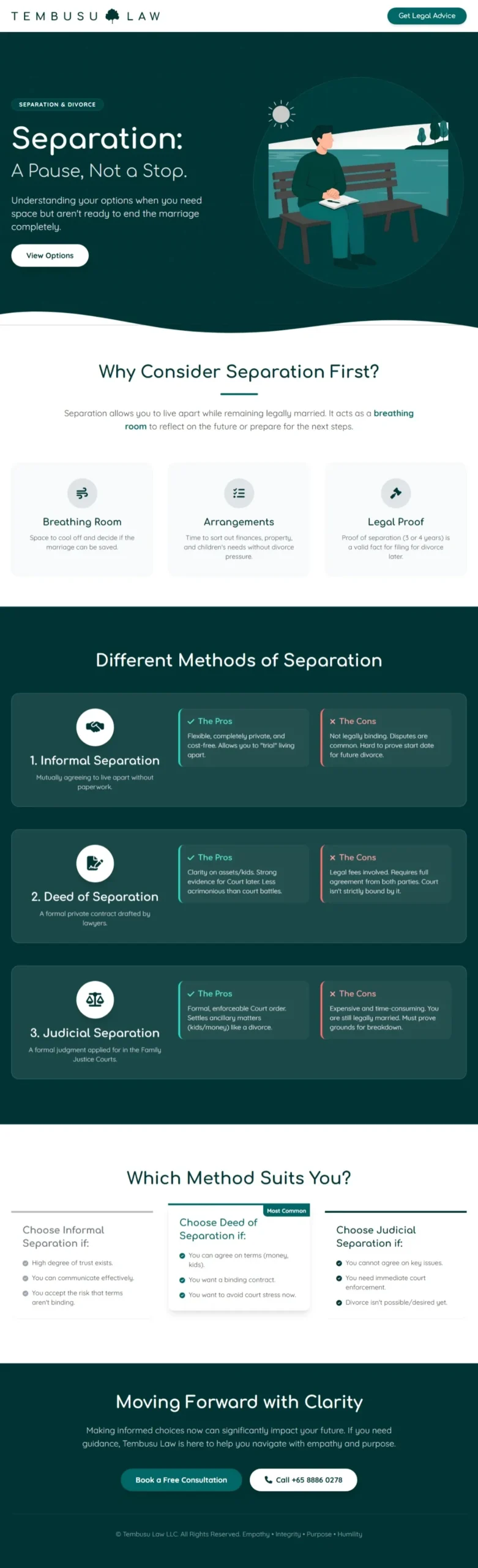
Why Consider Separation First?
Separation allows couples to live apart while remaining legally married. It can provide breathing room to decide on the future of the relationship or serve as a stepping stone towards Divorce, allowing time to sort out finances, property, and arrangements for children.
Proving a period of separation is also one of the facts you can use to show the Court that the marriage has irretrievably broken down if you later decide to file for Divorce.
Different Methods Of Separation

In Singapore, there are essentially three ways couples can separate:
1. Informal Separation
This is the most straightforward approach, in which spouses mutually agree to live separately without a formal written agreement or Court order. They decide between themselves on living arrangements, finances, and care for any children.
Pros: It’s flexible, private, and doesn’t involve legal costs initially. It allows couples to trial living apart.
Cons: Because nothing is formally documented or ordered by the Court, agreements can be easily disputed. There’s little legal protection if one party changes their mind about financial support or access to children. Proving the date of separation for future Divorce proceedings can sometimes be harder without documentation.
2. Deed of Separation
This involves both spouses signing a formal written agreement, essentially a private contract, drafted with the help of lawyers. This Deed of Separation outlines the terms of the separation, covering aspects like division of assets, maintenance for the wife and/or children, custody, care and control, and access to children.
Pros: It provides clarity and certainty on agreed terms, reducing potential conflict later. It’s a legally binding document between the parties and can be used as strong evidence in subsequent Divorce proceedings, often forming the basis for a consent Court order. It’s generally less expensive and acrimonious than going through the Court for Judicial Separation.
Cons: Drafting the Deed involves legal fees. While binding the spouses, the Court is not strictly bound by the Deed during Divorce proceedings, although it gives it significant weight if it is fair and properly executed. Both parties must agree on the terms; if they don’t, this option isn’t feasible.
3. Judicial Separation:
This is a formal Court process where one spouse applies to the Family Justice Courts for a Judgment of Judicial Separation. To succeed, the applicant must prove that the marriage has irretrievably broken down based on one of the same facts required for Divorce (e.g., adultery, unreasonable behaviour, desertion, or separation of 3 years with consent / 4 years without consent).
Pros: It results in a formal Court order legally recognising the separation and allows the Court to make orders on crucial matters like asset division, maintenance, and children’s issues, similar to a Divorce, but without terminating the marriage. This offers legal enforceability.
Cons: It’s a Court process, involving legal costs, time, and potential acrimony, much like a Divorce. Parties are still legally married and cannot remarry. The grounds for Judicial Separation must be proven in Court.
Which Method Of Separation Is Suitable?

Deciding which separation method is best depends mainly on how well you and your spouse can communicate and agree, and whether you need legally enforceable terms immediately.
- Choose Informal Separation if: You have a high degree of trust and can communicate effectively to manage living apart, finances, and children’s arrangements yourselves. However, be aware that agreements made this way aren’t legally binding and can be easily disputed if things change.
- Choose a Deed of Separation if: You and your spouse can negotiate and agree on specific terms (like asset division, maintenance, children’s issues) and want a formal, binding contract to document these agreements without going to Court right away. This offers more security than an informal arrangement and is usually less costly and stressful than Judicial Separation.
- Choose Judicial Separation if: You cannot reach an agreement with your spouse on key issues, or if you need Court orders to enforce terms like maintenance or child access arrangements immediately. It’s a formal Court process similar to Divorce (requiring proof of marital breakdown), but doesn’t end the marriage, making it suitable if Divorce isn’t yet desired or possible, but legally binding orders are necessary.
Conclusion About The Different Methods Of Separation
Navigating the complexities of marital separation requires careful thought. Understanding the available methods of separation in Singapore – informal, via a Deed, or through the Court via Judicial Separation- allows you to choose the path that best suits your family’s needs before potentially proceeding with Divorce.
Making informed choices now can significantly impact your future arrangements. If you need guidance on separation or Divorce matters, contact Tembusu Law, home to some of the best Divorce lawyers in Singapore who also possess deep expertise in criminal law, for advice tailored to your situation.
Contact us today for a free discovery call!
Frequently Asked Questions About The Different Methods Of Separation
What Is The Difference Between Separation And Divorce In Singapore?
Separation means living apart while still legally married. Divorce legally ends the marriage, allowing parties to remarry. Judicial Separation and Deeds of Separation can settle ancillary matters like assets and children, similar to a Divorce, but the marriage itself remains intact.
Do We Need To Sign A Deed Of Separation To Be Legally Separated?
No, you can be informally separated simply by living apart with the intention of separating. However, a Deed provides proof of the date of separation and formally records agreements on essential issues, which is highly recommended.
Can The Court Change What Was Agreed In A Deed Of Separation During Divorce?
Yes, the Court has the power to vary terms in a Deed if they are found to be unfair or not in the best interest of the children, although significant weight is usually given to Deeds that were properly negotiated with legal advice.
How Long Do We Need To Be Separated Before Filing For Divorce?
You can file for Divorce based on separation if you have lived apart for 3 continuous years and your spouse consents, or if you have lived apart for 4 continuous years (consent not required). Separation is just one of the facts used to prove marital breakdown.
Is An Informal Separation Recognised By The Court For Divorce Proceedings?
Yes, informal separation can be recognised if you can provide sufficient evidence to the Court of the date the separation started and that it has been continuous for the required period (3 or 4 years). Evidence can include separate addresses, utility bills, etc.