
Imagine this: your loved one passes away, and you go through the process of reading their will. It seems straightforward. The HDB flat goes to the spouse, and the car goes to the eldest child. The executor is appointed, and everything is in order.
Then, a month later, a bank statement arrives. It’s for an old savings account nobody knew about, and it contains a significant amount of money. You check the will again. It is not mentioned anywhere.
This discovery can cause a lot of confusion and stress. Does the executor decide who gets it? Does it go to the person who inherited the flat? This is a common problem, and it raises the important question: What happens to property not accounted for in a will?
It’s a frustrating situation, but thankfully, the law provides a clear and structured solution.
What Is Partial Intestacy?
This is the key legal term you need to know, and it’s the direct answer to your question.
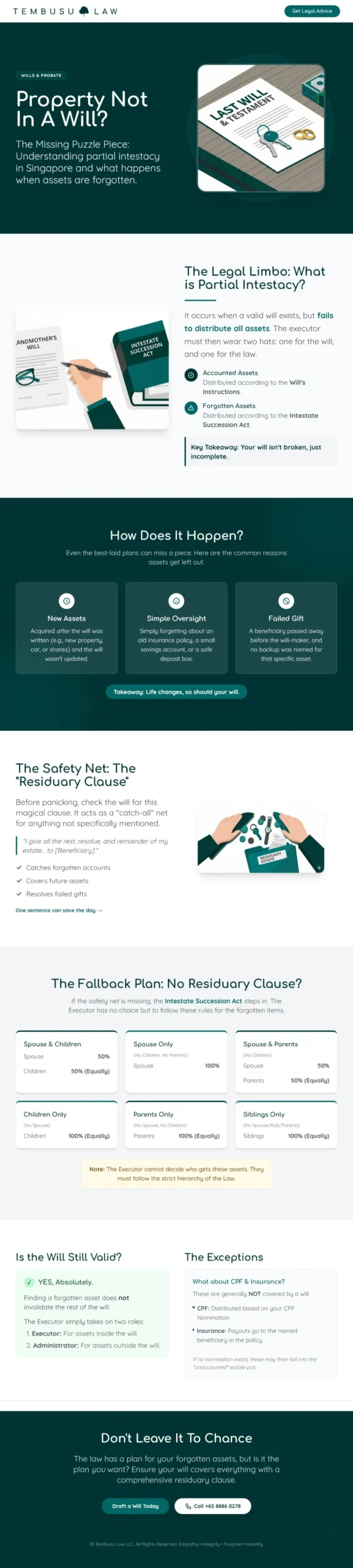
When a person leaves a valid will, but that will does not distribute all of their assets, the estate is considered to be in a state of “partial intestacy.” This means the property inside the will is distributed according to the will’s instructions. A separate set of rules governs the distribution of property left unclaimed, as outlined in the Intestate Succession Act.
Why Does Property Get Left Out of a Will?

This is a common issue that can happen for several reasons. It does not mean the will is invalid. It usually happens because:
- New Assets: The person acquired new property (like a car, shares, or a new bank account) after they wrote their will and never updated it.
- A Simple Oversight: They may have simply forgotten about an old insurance policy or a small savings account.
- A “Failed” Gift: A beneficiary named in the will may have passed away before the person who made the will. If there was no backup beneficiary named for that specific gift, the gift “fails” and becomes an unaccounted-for asset.
The First Place to Look: The “Residuary Clause”
Before you assume the law takes over, the very first step is to read the will again, very carefully. You are looking for one of the most important parts of any will: the “residuary clause.”
Think of this as a “safety net” or “catch-all” clause. A well-drafted will includes this to handle this exact problem.
Legally, any property not specifically mentioned in a will is called “residuary property.” This can happen for a few common reasons:
- The person acquired new property (like a new car or bank account) after they wrote their will.
- A specific gift “failed”, for example, the will left a watch to a friend, but that friend passed away before the will-maker.
- There was a simple oversight, and an old asset was accidentally left out.
A residuary clause prevents these assets from being left in limbo. It might say something like:
“I give all the rest, residue, and remainder of my estate, whatsoever and wheresoever, to my wife, [Name], absolutely.”
If the will has this clause, the problem is solved. The forgotten bank account, the new car, and the failed gift are all “caught” by this clause and go directly to the person named as the “residuary beneficiary” (in this case, the wife).
But what happens to property not accounted for in a will if this clause is missing? That is when the situation becomes a “partial intestacy,” and you must turn to the law.
What if There Is No Residuary Clause?
This is where the Intestate Succession Act comes in.
If there is no residuary clause, the executor must follow the law to distribute the forgotten assets. The executor has no personal discretion in this. The Act provides a strict hierarchy.
Here are the most common distribution rules for the unaccounted-for property:
| If the Deceased Leaves… | The Forgotten Asset Is Distributed As Follows: |
| Spouse and Children | 50% to the Spouse
50% shared equally among the Children |
| Spouse only (No Children, No Parents) | 100% to the Spouse |
| Spouse and Parents (No Children) | 50% to the Spouse
50% shared equally between the Parents |
| Children only (No Spouse) | 100% shared equally among the Children |
| Parents only (No Spouse, No Children) | 100% shared equally between the Parents |
| Siblings only (No Spouse, Children, or Parents) | 100% shared equally among the Siblings |
So, Is the Will Still Valid?

Yes, absolutely. This is a common point of confusion, but the answer is clear.
Finding a forgotten asset does not make the entire will invalid.
The will is still perfectly valid and legally binding for all the assets it does mention. The executor must still distribute the HDB flat to the spouse and the car to the child, exactly as the will commands.
The concept of “partial intestacy” means that only the forgotten, unaccounted-for assets are treated as if there were no will. The will itself remains the primary set of instructions.
The executor’s job simply expands. They must now act in two different capacities:
- As Executor for all the assets inside the will, following the will’s instructions.
- As Administrator for all the assets outside the will, following the Intestate Succession Act.
This is why understanding what happens to property not accounted for in a will is so important for an executor. They have a legal duty to the Court and the beneficiaries to distribute all assets correctly, whether they are listed in the will or not.
Conclusion About Properties Not Accounted For in a Will
Finding a forgotten asset can be a surprise, but it doesn’t have to be a crisis. The law has a clear plan. However, that plan might not be what your loved one actually wanted. They might have wanted their spouse to get that forgotten bank account, not have it split with their parents.
The only way to ensure all your property goes where you want it to is by having a professionally drafted will that includes a comprehensive residuary clause.
This is where legal guidance is invaluable. If you are an executor facing a partial intestacy, or if you want to draft a will that leaves no room for confusion, our team is here to help.
For expert guidance on probate or estate planning, contact our team at Tembusu Law, home to some of the best family and Divorce lawyers in Singapore.
Frequently Asked Questions About Properties Not Accounted For in a Will
What Is the Difference Between Partial Intestacy and Total Intestacy?
Total intestacy is when a person dies with no valid will at all, so the Intestate Succession Act distributes their entire estate. Partial intestacy is when a person leaves a valid will, but that will fails to distribute some of their assets.
Can the Executor Decide Who Gets the Forgotten Property?
No. The executor has no personal discretion or choice. They are legally bound to distribute the forgotten property according to the strict rules of the Intestate Succession Act (unless a residuary clause exists).
What Happens to CPF Monies or Insurance Payouts?
These assets are generally not covered by a will. CPF money is distributed based on a CPF nomination. Insurance payouts go to the named beneficiary on the policy. If no beneficiary is named on an insurance policy, the payout may become part of the estate and be treated as an “unaccounted for” asset.
Is a Will Invalid if It Is Old and Doesn’t Mention New Property?
No, the will is still valid. The assets listed in it will be distributed as planned. The new property acquired after the will was written will be considered “unaccounted for” and will be distributed according to the Intestate Succession Act (assuming no residuary clause).