
It is a topic many of us put off thinking about, but it is an important one, especially for those who have made Singapore their home away from home. When a foreign national passes away here, their family is often left wondering and worried.
They ask, “What happens to a Singapore expatriate’s assets when he passes on?”
It can seem like a complicated puzzle, mixing different legal systems. Let’s break down how it generally works, so you know what to expect.
How an Expat’s Assets are Handled Depends on ‘Domicile’ and Asset Type
To answer the main question directly: what happens to the assets depends on two key things. First is the deceased’s legal “domicile” (their permanent home country). Second is the type of asset. Immovable assets (like property) are governed by Singapore law. Movable assets (like bank accounts) are governed by the law of the person’s domicile.
What is Domicile and Why Does It Matter So Much?

Now, let’s look at that first part. The Singapore Court will check the deceased’s “domicile”.
Domicile is a legal concept for the country a person considers their permanent home, even if they live elsewhere as an expat. It is not the same as citizenship or residence. This is the first thing the Singapore Court will check because it determines which country’s laws are used to distribute some of the person’s assets.
For example, you could live in Singapore on an Employment Pass for 15 years, but if your heart and long-term intentions remain in your home country (say, France), your domicile would likely still be France.
Movable vs. Immovable Assets: A Key Difference
The law treats assets differently based on whether they are movable or not. Getting this right is essential.
| Asset Type | Definition | Examples | How It’s Handled |
| Immovable | Assets that cannot be moved, such as land and buildings. | A private condominium, land, or an HDB flat (if eligible). | Governed by Singapore law (the lex situs rule). |
| Movable | Personal property that can be moved from one place to another. | Money in a Singapore bank account, shares, cars, jewellery. | Governed by the law of the deceased’s country of domicile. |
Here is a simple scenario: An Australian expat (domiciled in Australia) passes away owning a condo in Novena and a DBS bank account.
- The condo (immovable) will be distributed according to Singapore’s laws.
- The bank account (movable) will be distributed according to Australian laws.
What Happens if the Expat Had a Will?
This is the most straightforward path.
If there is a Singapore Will: A Will written specifically for Singapore assets makes the process much simpler. The executor named in the Will just needs to apply to the Singapore Court for a Grant of Probate. This grant is a legal document that gives the executor authority to gather the assets (like closing bank accounts) and distribute them to the beneficiaries as stated in the Will.
If there is a Foreign Will: What if the expat only had a Will from their home country? That Will can often be used in Singapore, provided it is valid. The executor must first get the Grant of Probate from the Court in that home country. Afterwards, they can apply to the Singapore Court to “reseal” the foreign grant. Once resealed, it has the same power as a local Grant of Probate, allowing the executor to manage the Singapore assets.
What Happens if There Is No Will?
When a person passes on without a valid Will, it is called “dying intestate.” This is where things become more complex and costly.
- For Immovable Assets (Property): The assets will be distributed according to Singapore’s Intestate Succession Act. This Act has a fixed set of rules. For instance, if the deceased leaves a spouse and children, the spouse gets half, and the children share the other half.
- For Movable Assets (Cash, Shares): These will be distributed according to the intestacy laws of the deceased’s country of domicile. Those rules might be completely different from Singapore’s.
Instead of an executor, a family member (usually the next-of-kin) must apply to the Court for a Grant of Letters of Administration. This process is generally longer and requires the administrator to find two sureties (guarantors) for the estate’s value, which can be difficult.
What About CPF Money?

This is a common question for expats who became Permanent Residents.
CPF savings are not part of your estate and cannot be distributed using a Will.
CPF money is handled entirely separately. If the deceased person made a valid CPF nomination, the money will be paid out directly to their nominees, usually in cash. If no nomination was made, the CPF savings will be transferred to the Public Trustee’s Office, which will then distribute the funds according to the Intestate Succession Act.
Conclusion About Expat Assets in Singapore When He Passes On
Navigating this area can feel overwhelming, especially when grieving. The mix of foreign and local laws, and the strict Court processes for matters like Divorce or probate, require careful handling.
Understanding the basics of domicile and how different assets are treated is the first step. But you do not have to figure it out alone. To ensure your loved ones are protected and the process is managed smoothly, it is always best to seek professional legal advice.
For clear guidance on estate planning or administration, reach out to the team at Tembusu Law, home to some of the best family and Divorce lawyers in Singapore.
Contact us today for a free discovery call.
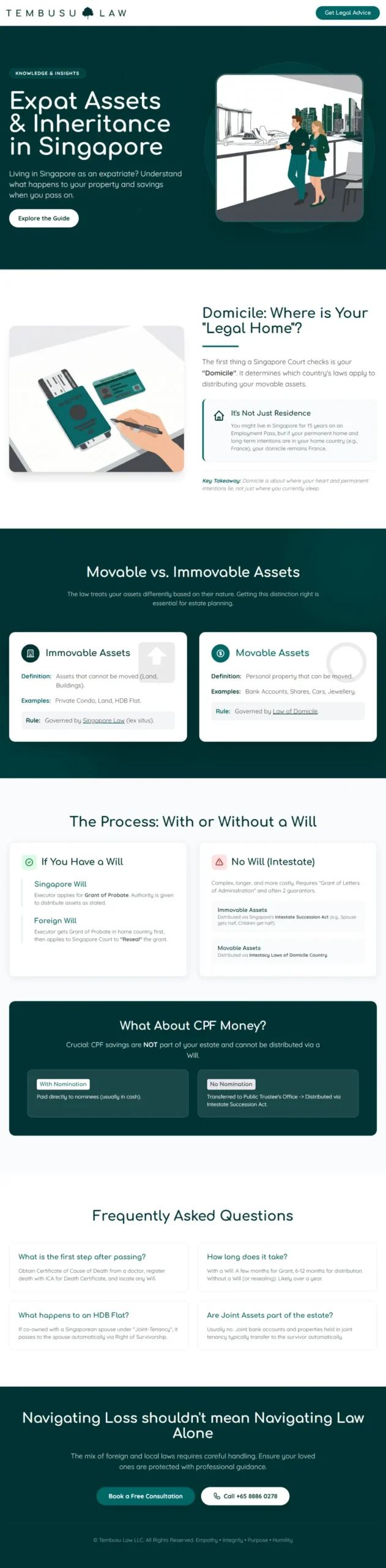
Frequently Asked Questions About Expat Assets in Singapore When He Passes On
What Is the First Step to Take When an Expat Passes Away in Singapore?
The immediate steps are practical: obtain a Certificate of Cause of Death from the doctor, register the death with the Immigration & Checkpoints Authority (ICA) to get the official Death Certificate, and then make funeral arrangements. You should also try to locate any Will and secure important documents.
How Long Does It Take to Settle an Expat’s Estate in Singapore?
It varies. If there is a straightforward Singapore Will, applying for a Grant of Probate can take a few months. After that, asset collection and distribution might take another 6 to 12 months. If there is no Will (intestacy) or if a foreign grant needs to be resealed, the process will likely take longer, often over a year.
Can an Expat Own an HDB Flat, and What Happens to It?
Generally, non-citizens cannot buy HDB flats directly. However, an expat might co-own a flat with a Singaporean spouse. If the ownership was under a joint-tenancy, the flat automatically passes to the surviving owner (the spouse) and does not form part of the deceased’s estate. This is known as the right of survivorship.
Are Jointly Owned Assets Part of the Estate?
It depends on how they are owned. For immovable property held in ‘joint tenancy’ (common for married couples), the property automatically transfers to the surviving joint tenant(s). For joint bank accounts, the same principle usually applies; the money becomes the property of the surviving account holder. However, this can sometimes be challenged in Court.