
Losing a loved one is an incredibly difficult and emotional time. Amid the grief, you may also be faced with sorting out practical matters, and a big one for many is figuring out what happens to hdb flat when one owner dies.
It can feel overwhelming, but the process is actually quite straightforward once you know where to look. The answer depends almost entirely on a single detail: how the flat was legally owned. This is known as the “manner of holding”.
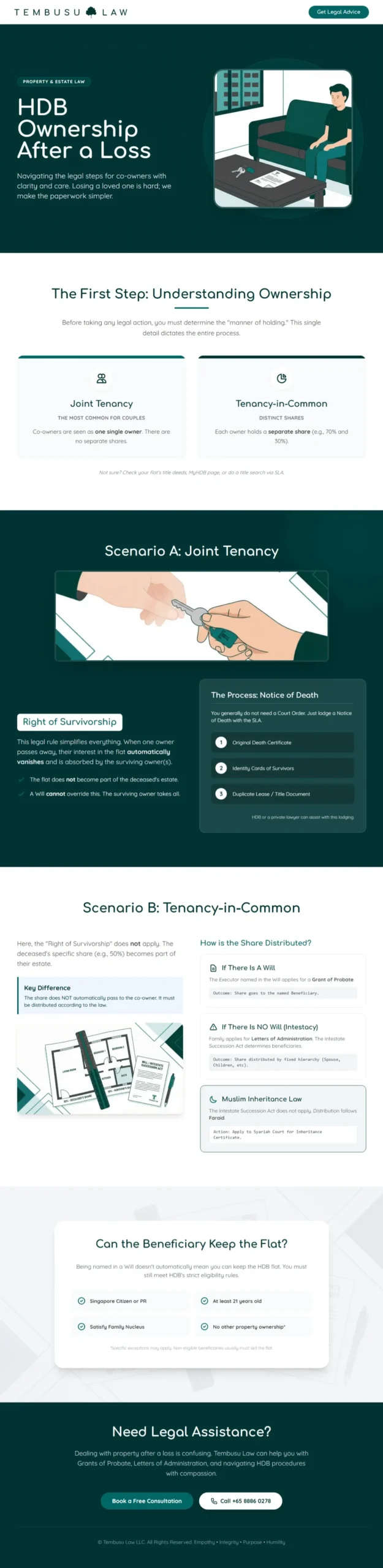
First, Check Your Flat’s Manner of Holding
Before any other steps are taken, you must find out the “manner of holding” for the HDB flat. This single legal detail determines the entire process of what happens to hdb flat when one owner dies. It is the fork in the road.
Was the flat held as a Joint Tenancy or a Tenancy-in-Common?
Most married couples buy their flat as joint tenants, but not always. You can find this information on the HDB flat’s documents, your MyHDB page, or by doing a title search with the Singapore Land Authority (SLA).
What Happens Under a Joint Tenancy?
This is the most common way married couples own their HDB flat. In a Joint Tenancy, all the co-owners are seen as one single owner of the entire property. There are no separate “shares”. Because of this, the process here is quite straightforward and is based on a legal rule called the “right of survivorship”.
How Does the Right of Survivorship Work?
The “right of survivorship” means exactly what it sounds like. When one owner passes away, their “interest” in the flat instantly vanishes and the surviving joint owner (or owners) automatically absorbs it.
The HDB flat does not become part of the deceased person’s estate. This is a crucial point: it means the flat is not covered by a will. Even if the deceased owner’s will states their “share” of the flat should go to their child, it will not happen. The Joint Tenancy rule overrides the will.
What is the Process to Transfer the Flat?
Legally, the surviving owner does not need to apply for a Grant of Probate or appear in court. The transfer is managed through a simpler administrative process. The survivor needs to lodge a “Notice of Death” with the Singapore Land Authority (SLA) to update the property records.
This can be done by engaging a private lawyer, or you can get assistance from HDB. HDB can assist you in preparing and lodging the necessary documents for a fee. You will need to provide key documents, including:
- The original Death Certificate
- Identity Cards of the surviving owners
- The original duplicate lease or title document (if you have one)
What Happens Under a Tenancy-in-Common?
This is the complete opposite of a Joint Tenancy. If the flat is held under a Tenancy-in-Common, each owner holds a separate and distinct share. For example, one owner might hold 70% and the other 30%. This is sometimes used when co-owners contribute different amounts. Because the shares are separate, there is no right of survivorship. The HDB scenario becomes very different if one owner dies.
How is the Deceased’s Share Distributed?
When the owner passes away, their specific share (such as 70% or 30%) does not automatically pass to the surviving co-owner. Instead, that share becomes part of the deceased’s estate, just like their bank accounts or other assets. From here, the distribution of that share depends entirely on whether the deceased person left a valid will.
What if There is a Will?
If there is a valid will, the family (or the “Executor” named in the will) must apply to the Court for a Grant of Probate. This Grant is the official legal document that gives the Executor the power to manage the deceased’s estate.
Once the Grant of Probate is obtained, the Executor can legally transfer the deceased’s share of the flat to the person named as the beneficiary in the will, provided that person is eligible to own an HDB flat.
What if There is No Will (Intestacy)?
When a person passes away without a will (known as dying “intestate”), their estate is distributed according to Singapore law, specifically the Intestate Succession Act. This Act sets out a fixed-rules hierarchy for who gets the assets.
For example, if the deceased has a spouse and children, the spouse gets half the estate, and the children share the other half. The family must apply to the Court for a Grant of Letters of Administration. This appoints an “Administrator” (usually a close relative) who has the legal authority to distribute the flat’s share in accordance with the Act’s rules.
What About Muslim Inheritance Law?
It is very important to understand that the Intestate Succession Act does not apply to the estate of a deceased person who was a Muslim. For a Muslim owner, their share of the HDB flat (if held as a Tenancy-in-Common) will be distributed according to Muslim inheritance law, known as Faraid.
The family will need to apply to the Syariah Court for an Inheritance Certificate, which will state how the deceased’s assets, including the flat share, are to be divided.
Who Is Eligible To Inherit The HDB Flat?
Just because you are named in a will or are a beneficiary under the Intestate Succession Act does not mean you can automatically take ownership of the HDB flat. HDB’s rules on ownership still apply. To inherit and keep the flat, a beneficiary must:
- Be a Singapore Citizen (SC) or Singapore Permanent Resident (PR).
- Be at least 21 years old.
- Satisfy HDB’s other eligibility rules, such as the family nucleus requirement (though this may be waived in some inheritance cases).
- Do not own other property, unless they meet specific exceptions (more on this below).
Conclusion About The HDB Flat When One Owner Dies
Understanding your flat’s ownership structure is the key to a smoother transition during a hard time. A Joint Tenancy provides a simple, automatic transfer, while a Tenancy-in-Common follows estate law.
Dealing with property after a loss is confusing. If you are facing this situation or need help with a Grant of Probate or Letters of Administration, reach out to Tembusu Law. Our team has the best family and Divorce lawyers in Singapore and can guide you with clarity and compassion.
Contact us today to schedule a free discovery call.
Frequently Asked Questions About The HDB Flat When One Owner Dies
How Do I Find Out if My Flat Is Under Joint Tenancy or Tenancy-in-Common?
You can find this information on the property’s Title Deed, the original documents you signed when you bought the flat, or by running a title search through the Singapore Land Authority (SLA).
Can a Will Override a Joint Tenancy?
No. The right of survivorship in a Joint Tenancy is a rule of law that takes precedence over a will. The flat will automatically pass to the surviving joint tenant.
What Happens if the Surviving Co-Owner Is Not a Singapore Citizen?
If the surviving joint tenant is a Permanent Resident (PR), they can take ownership. However, if they are not an SC or PR, they may not be eligible to keep the flat and will likely have to sell it within a timeframe set by HDB.
We Had a Joint Tenancy but Are Now Getting a Divorce. What Should We Do?
During Divorce proceedings, it is very common to apply to the Court to sever the Joint Tenancy. This changes the ownership to a Tenancy-in-Common, allowing each party to have a distinct share that can be divided or sold as part of the settlement.