
Losing your partner is an overwhelming experience. Amid the grief, you are suddenly faced with practical tasks, and one of the most pressing is managing finances. You might be wondering, if your spouse dies, what happens to the bank account? It’s a common and stressful question.
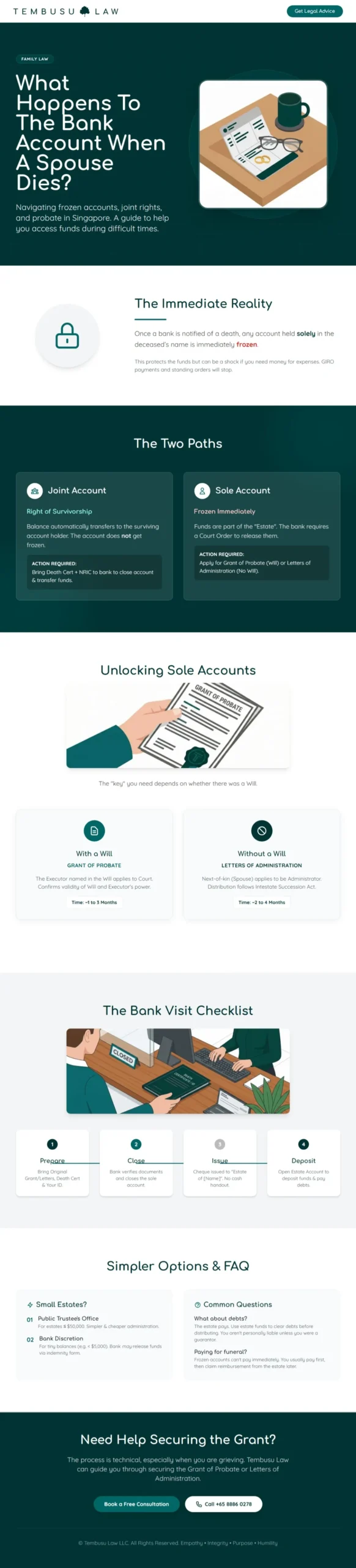
In short, once a bank is notified of a death, it will immediately freeze any account held solely in the deceased’s name.
This is a standard step to protect the funds. But it can be a shock if you need that money for household expenses. How you get access depends on one main thing: was it a joint account or a sole account?
Here is a straightforward guide to help you understand the process.
What Happens To A Joint Bank Account When A Spouse Dies?

This is often the most direct and simple part of the process. For most joint accounts, a legal principle known as the “right of survivorship” applies.
In plain English, this means that when one account holder passes away, the entire account balance automatically transfers to the surviving account holder. The money does not get “stuck” in the estate and does not require a Court order to access.
This is a common feature of joint accounts and is part of the standard terms and conditions you agree to when opening one with a bank.
What This Means for You
Practically speaking, you can usually access the funds in a joint account relatively quickly. You will need to inform the bank of your spouse’s passing and provide them with the necessary documents.
This will always include:
- The original Death Certificate (or a certified true copy).
- Your own NRIC or passport for identification.
- The bank may also have its own forms for you to sign.
Once the bank has processed these documents, it will release the account. They will typically close the joint account and assist you in transferring the full balance to a new or existing account held in your sole name. This is a key answer to can a spouse can access a bank account after death: for joint accounts, the answer is generally yes, and without needing a Court order.
How To Access A Deceased Spouse’s Sole Bank Account In Singapore
If the bank account were only in your spouse’s name, the rules would be completely different. You cannot simply walk in and withdraw the money, even with a death certificate.
The moment the bank is officially notified of the death, it is legally required to freeze the account. This means no money can go in or out. All GIRO payments, standing orders, and direct debits will stop. This is done to protect the funds, which are now considered part of your spouse’s “estate”.
To get access, you must first become the official legal representative of that estate. The bank has no authority to decide who gets the money; only the Court does. You prove your authority to the bank by showing them a specific Court order. The type of order you need depends on one key fact: did your spouse leave a will?
What to Do If Your Spouse Had a Will (Grant of Probate)
If your spouse prepared a valid will, that document will name an “Executor”. The Executor is the person (or people) trusted to carry out the will’s instructions. Often, this will be the surviving spouse.
However, the will by itself is not enough for the bank. You must first get it validated by the Court. You do this by applying to the Family Justice Courts for a Grant of Probate.
This Grant is an official Court document that does two things:
- It confirms that your spouse’s will is their last, valid one.
- It officially appoints you as the Executor, giving you the legal power to manage the estate.
This Grant of Probate is the “key” the bank needs. It proves you are the only person legally allowed to access the account, pay off any of your spouse’s debts, and then distribute the rest of the money according to the wishes in the will.
What to Do If Your Spouse Did Not Have a Will (Letters of Administration)
When a person passes away without leaving a will, it is known as dying “intestate”. In this situation, there is no will to say who gets what or who is in charge.
So, the law steps in. You will need to apply to the Family Justice Courts for Letters of Administration. This is a different Court document that appoints one or more people (usually the closest next-of-kin) as the “Administrator” or “Administratrix”.
As the surviving spouse, you have the first right under the law to apply for this role. Once the Court grants you the Letters of Administration, you have the same legal powers as an Executor: to access bank accounts, pay debts, and manage the estate.
The primary difference lies in how the money is distributed. Instead of following a will, you must distribute the estate’s assets according to the Intestate Succession Act. This is a fixed legal formula that, for example, states that if the deceased left a spouse and children, the spouse gets 50% of the estate, and the children share the other 50%.
What Is the Practical Process at the Bank?

Once you have successfully gone through the Court process and have the original Grant of Probate or Letters of Administration in your hand, you can finally settle the bank account.
You (and any co-executors or co-administrators) must go to the bank in person. Be sure to bring:
- The original Grant of Probate or Letters of Administration. The bank requires an official document bearing the Court’s seal.
- The original Death Certificate.
- Your own NRIC or passport (and those of any other appointed representatives).
The bank staff will verify these documents and make copies of them. They will then proceed to close your spouse’s sole account.
They will not hand you cash or transfer the money to your personal account. Instead, they will issue a cheque or cashier’s order for the full balance, made payable to “The Estate of [Your Spouse’s Name]”.
Your next step is to open a new bank account in that exact estate name. You deposit this cheque into the new estate account. This account is now the central point from which you will pay all the estate’s debts (taxes, loans, etc.) before distributing the remaining funds to the correct beneficiaries.
Is There a Simpler Way for Small Estates?
Yes. Dealing with the Court can be a long process. There are two simpler options for smaller, straightforward estates.
1. The Public Trustee’s Office
If your spouse’s total estate is valued at $50,000 or less (excluding CPF funds), you may be able to use the services of the Public Trustee’s Office. They can help you administer the estate for a fee, which is often a simpler and cheaper process than applying for a full Grant from the Court.
2. Very Small Account Balances (Less than $5,000)
Some banks may, at their own discretion, agree to release funds without a Grant of Probate or Letters of Administration if the amount is very small (e.g., less than $5,000). You would need to sign an indemnity form, promising to be responsible if another person makes a claim against you. This is not a legal right, but it is worth asking the bank manager about this possibility.
Conclusion About The Bank Account Of A Deceased Spouse In Singapore
Navigating the financial world after a loved one’s death is a challenge. Remember, the process is clear: joint accounts are generally straightforward, while sole accounts require a Court order (a Grant of Probate for a will, or Letters of Administration for no will) unless the estate is very small.
This process can be confusing and technical, especially when you are grieving. You do not have to do it alone. If you need help securing a Grant of Probate or Letters of Administration, contact Tembusu Law. Our team of the best family and Divorce lawyers in Singapore can guide you with compassion and clarity.
Reach out to us for a free discovery call today.
Frequently Asked Questions About The Bank Account Of A Deceased Spouse In Singapore
What Is The Difference Between A Grant Of Probate And Letters Of Administration?
A Grant of Probate is issued by the Court when a person dies with a valid will, giving the named Executor authority to act. Letters of Administration are issued when a person dies without a will, appointing an Administrator (usually the next of kin) to manage the estate.
How Long Does It Take To Get The Grant Of Probate Or Letters Of Administration?
This depends on the complexity of the case. A straightforward application for a Grant of Probate can take about 1 to 3 months. An application for Letters of Administration can take a bit longer, typically 2 to 4 months, as it involves more steps.
What Happens To My Spouse’s Debts Or Loans?
The estate pays debts. You, as the Executor or Administrator, must use the money from the estate (including the bank accounts) to pay off any outstanding debts (like credit cards or loans) before distributing the remaining assets to the beneficiaries. You are not personally liable for your spouse’s debts unless you were a joint borrower or a guarantor.
Can I Use My Spouse’s Money To Pay For The Funeral?
Since the sole account is frozen, you cannot withdraw money for the funeral. You will likely need to pay the funeral expenses first, and then you can claim reimbursement from the estate once you have obtained the Grant of Probate or Letters of Administration and accessed the funds.