
Losing a loved one is incredibly difficult. Amid the grief, there are also practical matters to sort out, which can be overwhelming. A common question that comes up is: What happens to the car when the owner dies? It’s not just a piece of metal; it’s a valuable asset, and sometimes a sentimental one.
This guide will walk you through the necessary steps to handle this situation properly, without the complicated legal jargon.
What Happens to the Car Immediately After the Owner Passes Away?
The short, simple answer is: the car should not be driven.
It can be very tempting, especially if it’s the family’s main vehicle, to simply keep using it. But the moment the owner passes away, the car’s legal status changes.
First and foremost, the car insurance policy, which was in the deceased’s name, is very likely void. Driving that car means you are driving uninsured, which is illegal and poses a significant financial risk if an accident were to happen.
Legally, the car is now considered “locked” as part of the deceased’s estate. No one has the automatic right to use, sell, or even give it away. The safest thing to do is to park the car in a secure location and initiate the legal process to sort out ownership, which we’ll cover next.
Is the Car Considered Part of the Deceased’s Estate?

Yes, 100%.
When a person passes away, everything they own (their assets) and everything they owe (their liabilities) are bundled together into what’s legally called their “estate.” A car is a tangible, valuable asset, just like a property, bank accounts, or jewellery.
Because the car is part of the estate, it is essentially frozen until the Court gives someone the legal authority to manage it. This person is either an “Executor” (if there’s a Will) or an “Administrator” (if there’s no Will).
Only this appointed person has the right to access the estate’s assets, pay its debts, and then legally transfer the car to a beneficiary or sell it. You cannot just find the spare keys and claim the car, even if you are the closest family member.
What If the Owner of the Car Dies With an Outstanding Car Loan?
This is a very common and stressful question. The car loan does not disappear when the owner passes away; it becomes a debt of the estate.
The finance company (the lender) is a creditor of the estate. This means they have a legal right to be paid back what is owed before any beneficiaries can inherit the assets.
Here’s what generally happens:
- The Executor or Administrator must contact the finance company to inform them of the death.
- The estate is responsible for paying off the remaining balance of the loan. This money is usually taken from the deceased’s bank accounts or other assets.
- The car cannot be legally transferred to a beneficiary or sold until the finance company confirms the loan is fully settled.
If the estate has enough money, it can pay off the loan, and the car will then be “free and clear” to be transferred. If the estate doesn’t have enough cash, the car might have to be sold. The sale proceeds are used to pay off the loan first, and any remaining funds are reinvested in the estate.
How Do You Legally Transfer the Car’s Ownership?

You cannot just pass the keys to a new owner or sell the car, even if you are the closest family member. The law requires a formal process to prove you have the right to handle the deceased’s property.
To get this right, you must first get a specific legal document from the Court. This document is your official “permission slip,” proving you are the person legally authorised to manage the deceased’s assets. This person is referred to as the “legal representative.” The exact document you need depends on one simple question: did the person leave a Will?
If There Is a Will (Grant of Probate)
A Will makes the process much more straightforward. In this document, the deceased owner would have named an “Executor.” This is the person they trusted to carry out their final wishes and manage their estate.
The Executor’s first job is to apply to the Family Justice Courts for a “Grant of Probate.” Think of this Grant as the Court’s official stamp of approval. It’s a legal document that confirms the Will is valid and officially gives the Executor the power to “administer the estate.”
This means they can now legally access the deceased’s bank accounts (to pay off any debts, like the car loan) and, crucially, handle the transfer or sale of the car.
If There Is No Will (Grant of Letters of Administration)
What happens if a car owner dies without leaving a Will? This is very common, and in legal terms, it’s called dying “intestate.”
When this happens, there is no Will to name an Executor. Instead, the law decides who is next in line to manage the estate. The Intestate Succession Act outlines a priority list, which typically begins with the surviving spouse, followed by the children, and then the parents.
This person must apply to the Court for a “Grant of Letters of Administration.” This Grant serves the same purpose as a Grant of Probate: it is the Court’s official appointment. It names the applicant as the “Administrator,” granting them the legal authority to settle the estate’s debts and distribute all assets (including the car) in accordance with the fixed rules outlined in the Act.
What is the Process with the LTA?
Okay, so you have done the hard part and successfully received the Grant of Probate or Letters of Administration from the Court. Now that you have the legal authority, you can finally deal with the car.
The actual ownership transfer happens at the Land Transport Authority (LTA). The appointed Executor or Administrator must handle this. You will generally need to present a set of key documents, which include:
- The original Grant of Probate or Letters of Administration (this is your proof of authority).
- The original NRIC of the Executor or Administrator.
- The original death certificate of the deceased owner.
- The vehicle’s log card details.
Once the LTA has verified your authority, you have three main choices for the car:
- Transfer the vehicle to a beneficiary (the person who will inherit it). That person becomes the new registered owner and will be responsible for getting new insurance and paying road tax.
- Sell the vehicle to a third party, like a used car dealer or a private buyer. The sales money then goes back into the estate to be distributed to the beneficiaries.
- De-register the vehicle if it’s old, in poor condition, or no one wants it. This means scrapping the car permanently.
What About the COE and Road Tax?
This is a great question, especially since the COE (Certificate of Entitlement) is often the most valuable part of a car.
The key thing to know is that the COE is tied to the vehicle, not to the owner. What happens to a car when the owner dies does not make the COE vanish.
- If you transfer or sell the car: The new owner receives the car with its remaining COE. The value of that remaining COE is simply part of the car’s total value.
- If you deregister the car: The estate can claim a rebate for any unused portion of the COE and any road tax that was paid in advance. This rebate, which can be a substantial amount of money, is paid back to the estate and will be used to settle debts or distributed to the beneficiaries.
Conclusion About The Deceased Car’s Ownership In Singapore
Figuring out what to do with a loved one’s car is a difficult part of an already stressful time. It involves legal steps with the Court and administrative ones with the LTA. Getting it right ensures you are following the law and respecting the deceased’s estate. If you feel lost in this process or are facing complications with estate matters, you don’t have to do it alone.
Reach out to the experienced team at Tembusu Law, home to some of the best family and Divorce lawyers in Singapore, for clear and compassionate guidance.
Contact us today to schedule a free discovery call.
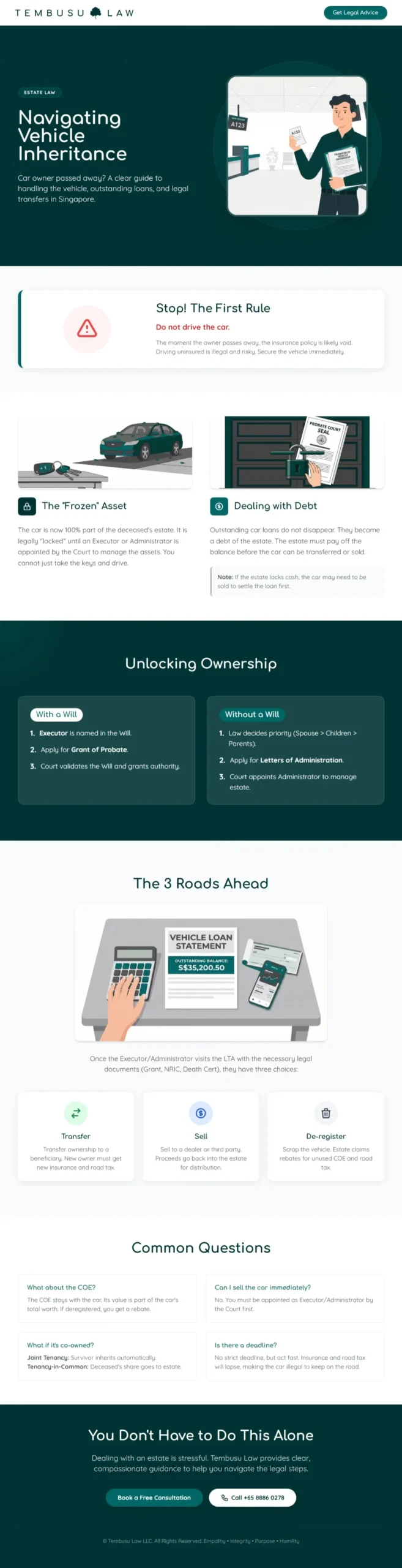
Frequently Asked Questions About The Deceased Car’s Ownership In Singapore
How Long Do I Have To Transfer The Car Ownership After Death?
There is no strict deadline, but it’s best to start the process soon. The car cannot be used, and road tax or insurance will lapse. You must first obtain the Grant of Probate or Letters of Administration from the Court, which can take a few months.
Can I Sell The Deceased’s Car Immediately?
No. You must first be legally appointed as the Executor or Administrator by the Court (with the Grant of Probate or Letters of Administration). Only then do you have the legal authority to sell the car.
What Happens If The Deceased Co-Owned The Car?
This depends on the type of co-ownership. If it were a “joint tenancy,” the surviving owner usually inherits the car automatically. If it were a “tenancy-in-common,” the deceased’s share of the car goes to their estate and must be handled through the probate process.
Does The Car Insurance Automatically Cancel When The Owner Dies?
In most cases, yes, the policy is void upon the owner’s death. You must contact the insurance company immediately to inform them. The new owner will need to get a new insurance policy in their own name before driving the car.